
Turn evidence into better decisions, stronger organizations and practical innovation.
Your organization may be preparing to grow, seeking greater impact, improving how people work together, or developing a new solution. The ambition is clear. Less clear may be which decisions to make, what needs to change, and whether the organization is equipped to deliver.
A business may need to strengthen the systems and capacities supporting its next stage of growth. A larger NGO may need to understand why results vary across programmes and how to use that knowledge across teams. An innovation team may need to establish what science already knows before investing in a new approach.
Evidence-Based Development International (EBD International) helps connect these questions with practical responses. We support businesses and NGOs through applied social research, scientific knowledge translation, evidence interpretation, strategy and planning, organizational capacity development, monitoring and evaluation, and organizational and strategic learning. Methodological innovation and responsible technology integration strengthen this work and can also be direct starting points for an engagement.
You can engage us for a focused assignment or a connected programme of support. The scope follows your challenge, not a requirement to use every service.
Find your starting point
Our approach connects four areas of organizational progress:

| Your starting point | The question you need to address | Services you can engage |
| Science & Evidence | What do we need to understand, and what is already known? | Applied research, assessments, scientific evidence reviews and knowledge translation. |
| Insight & Decisions | What does the evidence mean for our choices? | Evidence synthesis, interpretation and decision support. |
| Strategy & Action | What should we prioritize, and what will enable delivery? | Strategy and planning, capacity diagnosis and organizational development. |
| Learning & Improvement | What is working, what should change and how do we learn? | Monitoring and evaluation, organizational learning and strategic learning. |
This is a connected process, not a fixed sequence. You can begin with an evaluation, a strategic question, a capacity gap, a collaboration challenge or an opportunity to apply artificial intelligence. Monitoring can be designed before implementation begins, and learning can inform every stage.
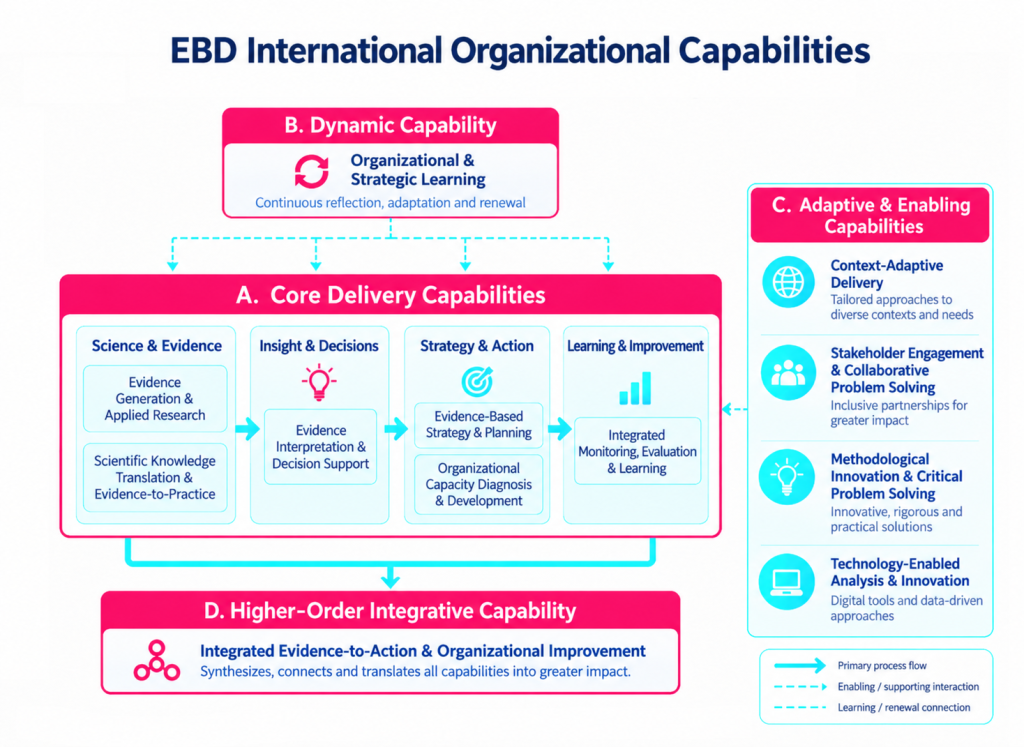
Our services describe the work you can commission. Our organizational capabilities explain how we connect expertise, methods, knowledge and ways of working to deliver it. The four groups below show how those capabilities reinforce one another; they are not separate departments or mandatory packages.
The deliverables described below are examples. The specific outputs, responsibilities and measures of progress are agreed for each assignment.
A. Core Delivery Capabilities
Our core delivery capabilities connect the generation and use of knowledge with strategic choices, organizational capacity and performance improvement.
Science & Evidence
1. Evidence Generation and Applied Research
When an important decision depends on something your organization does not yet understand, the first task is to ask the right question.
Why are results different across locations? What do employees, partners or programme participants experience that existing information does not explain? Which organizational conditions are supporting or limiting performance?
Our services. We design and deliver applied research and assessments, combining qualitative and quantitative methods where appropriate. The work connects problem definition, research design, ethical stakeholder engagement, data quality, analysis and interpretation around the decision you need to make.
Possible deliverables. A research design and data-collection tools; an analytical report; findings and recommendations with clear methodological limitations.
What this supports. A more credible understanding of the challenge and a stronger foundation for decisions where existing information is insufficient, outdated or poorly matched to your needs.
2. Scientific Knowledge Translation and Evidence-to-Practice
Your organization may not need to discover an answer from the beginning. It may need to put existing scientific knowledge to work.
The challenge is determining which findings are reliable, whether they apply to your circumstances and how they can inform a practical response.
Our services. We identify, critically assess and synthesize relevant scientific evidence, then translate it into approaches that decision-makers and practitioners can use. We consider scientific knowledge alongside organizational experience, stakeholder perspectives and implementation constraints. Where an approach is new to a setting, adaptation and testing form part of the work.
Possible deliverables. An evidence review; a practical decision framework; a science-informed tool, organizational practice or intervention design; an adaptation and testing plan.
What this supports. Better use of existing knowledge, a clearer foundation for innovation and a stronger basis for decisions. We distinguish well-supported findings from emerging or contested evidence rather than presenting science as a guarantee of success.
Insight & Decisions
3. Evidence Interpretation and Decision Support
Having information is not the same as knowing what to do with it.
Your organization may already hold research, monitoring data, evaluations and stakeholder feedback, yet still face uncertainty about the next decision. Different sources may point in different directions, or several options may involve competing risks and priorities.
Our services. We synthesize and interpret available evidence around a specific decision. We examine patterns, differences and inconsistencies, clarify the implications of findings and distinguish evidence from assumptions. Options and recommendations are developed with attention to trade-offs, uncertainty and the information still needed.
Possible deliverables. An evidence synthesis; a decision brief; an analysis of options and implications; a presentation of findings and actionable recommendations.
What this supports. A clearer basis for leadership and operational decisions, without implying that evidence removes the need for judgement. This is a useful starting point when information exists but its practical meaning remains unclear.
Strategy & Action
4. Evidence-Based Strategy and Planning
A strong mission and committed people do not automatically produce clear priorities.
A growing organization may face more opportunities than it can pursue. An established strategy may no longer reflect new evidence or changing conditions. Teams may be working hard without a shared understanding of what matters most.
Our services. We support strategy development, strategic review and practical planning. We bring together evidence, organizational purpose, stakeholder perspectives, capabilities and resource constraints to clarify priorities, intended results and choices about what to pursue, sequence or deprioritize.
Possible deliverables. An organizational strategy or strategic review; strategy execution plan; a prioritized action plan; defined responsibilities and resource implications; measures for reviewing progress, impact assessments.
What this supports. An executable direction that connects strategic ambition with resource allocation and everyday work. The purpose is not simply a strategy document, but a shared basis for decisions and coordinated implementation.
5. Organizational Capacity Diagnosis and Development
A clear direction brings a second question into focus: are we equipped to deliver it?
A business may outgrow its existing ways of working. A larger NGO may depend on capacities that vary across teams, partners or locations. In either case, a performance gap may involve more than individual knowledge or skills.
Our services. We assess organizational, team and individual capacity needs and design targeted development responses. Diagnosis considers competencies alongside roles, coordination, leadership practices, knowledge, systems and processes. Support may combine structured learning, mentoring, practical application and improvements to organizational routines.
Possible deliverables. A capacity assessment; a prioritized development plan; tailored learning and mentoring activities; revised processes, responsibilities or working arrangements.
What this supports. Stronger organizational ability to implement decisions and sustain improved practice. Training is one possible contribution, not the assumed solution to every performance problem.
Learning & Improvement
6. Integrated Monitoring, Evaluation and Learning
Your organization needs to understand not only what was completed, but what changed and what should happen next.
An intervention may be progressing according to plan while its results remain uncertain. Existing monitoring may generate extensive reporting without answering the questions managers and practitioners need to address.
Our services. We develop quality assurance tools, monitoring tools and performance frameworks, conduct evaluations and connect findings with management and learning. We examine implementation, stakeholder experiences, intended and unintended results and, where evidence permits, why particular outcomes are occurring.
Possible deliverables. A quality assurance, monitoring, evaluation and learning framework; indicators and data-collection tools; an evaluation report; practical recommendations and questions for management review.
What this supports. Useful evidence for accountability, decision-making and improvement. Measurement should be proportionate to organizational needs and capacities, and can be established from the outset rather than added only at the end of an intervention.
B. Dynamic Capability
Learning that improves practice and renews direction
Organizational and strategic learning is both a service you can engage directly and a capability that strengthens the whole process. It connects what an organization discovers with decisions about how it works and where it is going.
7. Organizational and Strategic Learning
Sometimes the missing element is not another report, but a way to ensure that existing knowledge changes practice.
Lessons may remain with individual employees, reflection may be disconnected from decisions, or teams may improve execution without reassessing the assumptions behind their strategy.
Our services. We help diagnose learning needs, facilitate reflection, strengthen knowledge-sharing arrangements and establish practical connections between evidence, experience and decisions. Organizational learning examines how work can improve; strategic learning also asks whether current priorities, assumptions and approaches remain appropriate.
Possible deliverables. A learning diagnosis; an organizational learning framework or agenda; knowledge management; facilitated learning sessions; strategic assumption reviews; routines for recording, sharing and following up decisions arising from learning.
What this supports. A more consistent ability to retain useful knowledge, adapt practice and reassess direction. Monitoring and evaluation contribute to this work, but so do scientific knowledge, stakeholder feedback, experimentation and experience across teams.
C. Adaptive and Enabling Capabilities
Making the approach relevant, collaborative and practical
These capabilities strengthen how we deliver the work. They also offer direct entry points when your main challenge concerns context, collaboration, a non-standard problem or the responsible application of technology.
8. Context-Adaptive Delivery
An approach that works in one setting may need adjustment before it becomes useful in another.
For a business entering a different organizational environment or an NGO operating across diverse communities and institutions, the challenge is to preserve quality while responding to local conditions.
Our services. We assess contextual requirements and adapt methods, engagement approaches, analytical frameworks and delivery arrangements. We consider stakeholder circumstances, organizational capacities, institutional and cultural factors, resources and implementation constraints. The work identifies what must remain consistent and what should change.
Possible deliverables. A contextual assessment; an adapted methodology or tool; a context-specific engagement or delivery plan; a record of adaptations and their implications for evidence quality or comparability.
What this supports. Greater relevance and feasibility without compromising ethical standards, analytical credibility or methodological integrity. Adaptation does not mean changing conclusions to match expectations.
9. Stakeholder Engagement and Collaborative Problem Solving
The people involved in a challenge often hold knowledge that a technical analysis alone will not reveal.
Employees, leaders, partners, customers, communities and programme participants may understand different parts of the problem and the conditions required for a workable response.
Our services. We design and facilitate stakeholder engagement, consultation, participatory inquiry and collaborative interpretation. Contributions are connected to problem definition, analysis, strategy or solution development rather than collected as an isolated exercise. We consider accessibility, differences in power and whose perspectives might otherwise remain unheard.
Possible deliverables. A stakeholder engagement plan; facilitated consultations or problem-solving sessions; a synthesis of stakeholder perspectives; partnership review, due diligence, collaboratively developed priorities or proposed solutions.
What this supports. A fuller understanding of the challenge and more relevant, feasible responses. Collaboration does not require artificial consensus: disagreement can reveal important evidence while independent analytical judgement remains essential.
10. Methodological Innovation and Critical Problem Solving
Some challenges cannot be addressed adequately by an existing template.
An organization may be developing a new service or intervention, testing an unfamiliar idea or finding that standard approaches do not answer the question that matters.
Our services. We help frame the problem, examine assumptions, consider alternative explanations and develop or adapt methods. We combine knowledge from social research, evaluation, strategy, organizational learning and analysis to create a response suited to the challenge. Innovation may mean adapting an established framework, combining methods differently or developing a practical tool.
Possible deliverables. A clearly defined problem and set of assumptions; a tailored methodological framework; a prototype tool or approach; a plan for testing, assessment and refinement.
What this supports. Disciplined innovation grounded in evidence and explicit reasoning. The test is not novelty alone, but whether the approach offers a more appropriate and useful response to the problem.
11. Technology-Enabled Analysis and Innovation
A technology becomes valuable when it improves a defined part of the work, not simply when it is adopted.
Your organization may be exploring artificial intelligence, digital data collection, analytical tools, automation or better ways to share knowledge. The opportunity needs to be considered alongside the methods, skills and workflows surrounding it.
Our services. We assess suitable applications and support responsible technology integration in research, analysis, decision support, learning and delivery. We connect the choice of tools with practical needs, quality requirements, human oversight and the ability to verify outputs.
Possible deliverables. An assessment of technology opportunities and constraints; a proposed digital workflow; an integration and adoption plan; practical guidance for use, review and output verification.
What this supports. Purposeful use of technology, with attention to confidentiality, data protection and accountability. The scope follows the application and required expertise, rather than assuming that every task needs automation or artificial intelligence.
D. Higher-Order Integrative Capability
Connected support for organizational improvement
Some organizations need a focused technical contribution. Others face a problem that connects evidence, decisions, systems, people and learning. Integration brings the relevant capabilities together around that problem.
12. Integrated Evidence-to-Action and Organizational Improvement
When a challenge crosses organizational boundaries, the response needs to connect across them too.
A study may reveal a capacity gap. A strategy may expose the need for different monitoring arrangements. A new technology may require changes in responsibilities and learning practices.
Our services. We design connected assignments that combine the capabilities needed for the intended improvement. We link research questions with decisions, findings with strategic choices, plans with responsibilities and capacities, and implementation experience with learning and adaptation.
Possible deliverables. An integrated assignment design and improvement plan; coordinated outputs across relevant workstreams; implementation responsibilities and review arrangements that connect the different contributions.
What this supports. Continuity between understanding and action, rather than a collection of disconnected reports, plans or development activities. Integration supports the whole process; it is not an extra stage at the end or a requirement to use every capability.
Different challenges. Different routes into the process.
The following scenarios illustrate possible engagements. They are not case studies or claims about completed assignments.
A business exploring AI to improve a workflow
The starting point may be Technology-Enabled Analysis and Innovation. Before selecting a tool, the work examines the workflow, the quality required and where human judgement remains important. This may reveal unclear responsibilities or a need for staff development, bringing Organizational Capacity Diagnosis and Development into the assignment.
An agreed way to assess the change then connects the work with quality assurance/monitoring and learning. Possible outputs include a workflow assessment, an integration plan, staff guidance and criteria for evaluating usefulness. The purpose is a better-supported decision about whether and how the technology should be used, not adoption for its own sake.
A larger NGO turning evaluation findings into action
The organization already has an evaluation, but its implications have not been translated into consistent decisions across teams. The starting point is Evidence Interpretation and Decision Support: clarifying the findings, their limitations and the practical options they create.
The engagement may then connect with Evidence-Based Strategy and Planning and Organizational and Strategic Learning. Possible outputs include a decision brief, revised priorities, an action plan with named responsibilities and learning routines across programmes. The focus is the use of evidence, not commissioning another study without a clear need.
An organization developing a new solution
The starting point may be Scientific Knowledge Translation and Evidence-to-Practice: establishing what relevant research supports and where uncertainty remains. Stakeholder engagement helps assess the problem and practical conditions, while Methodological Innovation and Critical Problem Solving supports adaptation or development of the response.
Research or evaluation can then help test the approach. Possible outputs include an evidence review, a practical concept or tool and a testing plan. The aim is to clarify assumptions and strengthen the basis for decisions about further development, rather than present an untested idea as a proven solution.
How we shape an engagement
Begin with the decision, challenge or intended improvement
You do not need to identify the right capability before speaking with us. The starting point is what you need to understand, decide, change or develop. We explore the information already available, what remains uncertain and who needs to be involved.
Agree a scope that is proportionate to the need
An assignment can focus on a defined output, such as a study, evaluation, strategy, assessment or learning process. Where several capabilities are needed, their contributions can be connected in one agreed scope. Deliverables, responsibilities, timing, resources and review points should be clear from the outset.
Connect the outputs with their intended use
A report, framework or tool has a purpose beyond its production. We clarify how it is intended to inform decisions, who will act on it and what organizational conditions may affect its use. This helps identify when additional interpretation, capacity development or implementation support is needed.
Review progress and learn from application
Where the engagement includes implementation or follow-up, we connect review with evidence about what is changing and what requires adjustment. Delivering an output, using it in practice and demonstrating an improvement are different achievements; each needs appropriate evidence.
Quality you can assess
Our approach emphasizes relevance, methodological rigour, practical usefulness and transparent judgement. Research questions should connect with real decisions. Methods should fit the context. Conclusions should remain proportionate to the evidence, and recommendations should account for implementation conditions.
We distinguish scientific findings from assumptions, emerging ideas from tested approaches, and intended improvements from demonstrated results. Stakeholder participation, responsible technology use and clear communication support the work without replacing analytical independence or human accountability.
The aim is to leave your organization with knowledge it can use, decisions it can explain and practical arrangements that support action and learning.
Start with what matters to your organization now
You may need evidence before making a decision, a strategy that guides everyday priorities, stronger capacity to deliver, a learning process that changes practice or support to develop and test an innovation.
Begin with that need. The right combination of services can follow.
EBD International connects scientific knowledge, evidence and organizational experience with practical responses – helping businesses and NGOs strengthen their capacity to act, learn and improve the results they seek.
Implement with Excellence.